8171 Payment CNIC Check Online 2026: BISP April Payment Status Guide
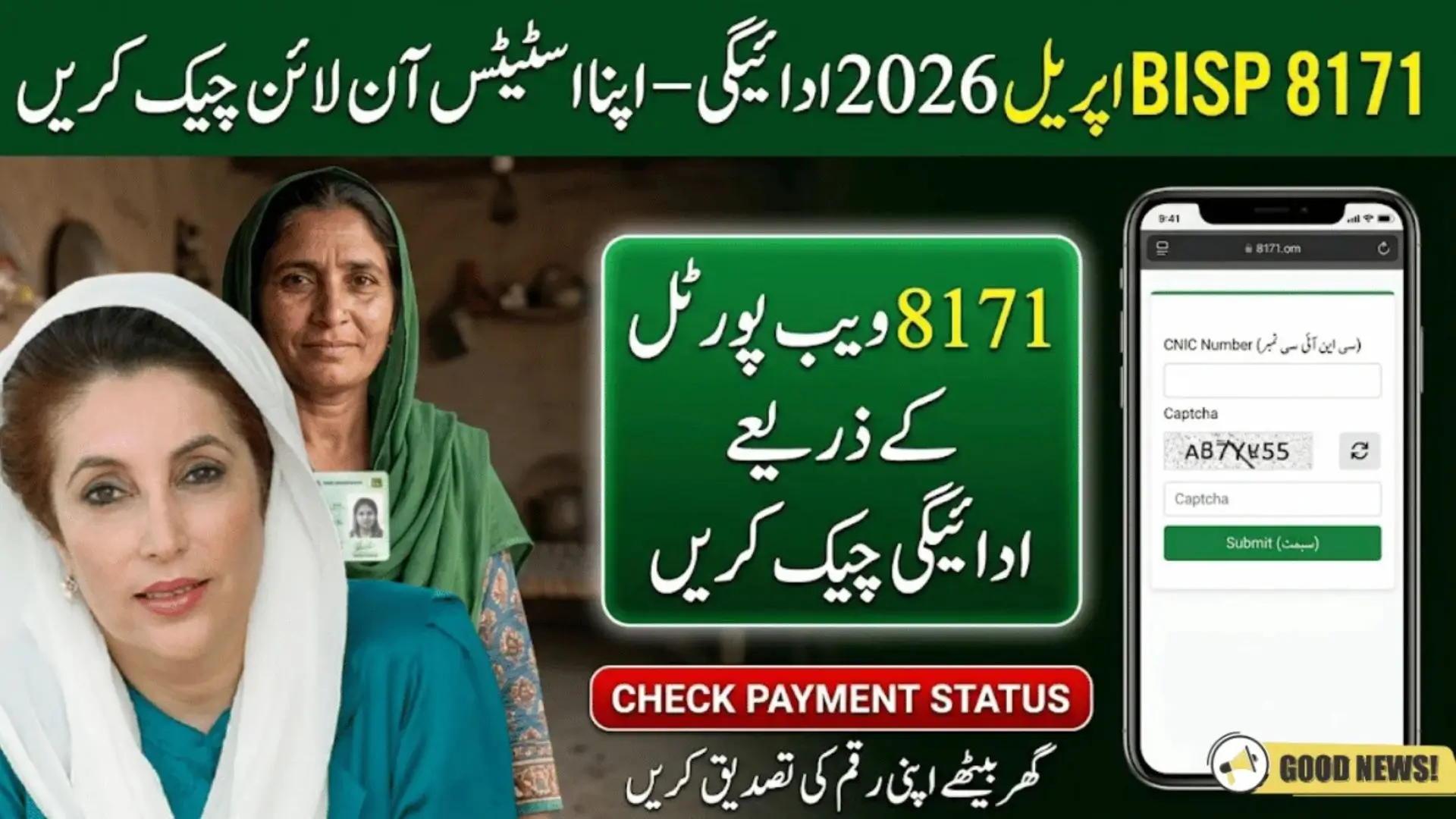
The 8171 Payment CNIC Check Online 2026 system represents a landmark evolution in how Pakistan delivers financial assistance to vulnerable families.

As living costs continue rising across the nation, the Benazir Income Support Programme (BISP) has streamlined its distribution mechanism—enabling millions of deserving households to verify their April 2026 payment status instantly from their mobile phones or computers.
Gone are the days of traveling to distant offices, waiting in lengthy queues, and relying on middlemen for basic information. The latest 2026 system delivers unprecedented transparency, speed, and accessibility.
Whether you’re a first-time applicant checking eligibility or a long-term beneficiary tracking your quarterly installment, this comprehensive guide walks you through everything you need to know.
Understanding the 8171 System: Pakistan’s Digital Welfare Gateway
What Is the 8171 CNIC Check System?
The 8171 system is BISP’s official digital verification platform designed specifically for low-income Pakistani families. By simply entering your Computerized National Identity Card (CNIC) number, you gain instant access to your complete financial assistance profile—no intermediaries, no paperwork, no delays.
| Feature | Benefit |
|---|---|
| 24/7 Availability | Check status anytime, including weekends and holidays |
| Zero Cost | Completely free service with no hidden charges |
| Universal Access | Functions on smartphones, feature phones, and desktop computers |
| Instant Verification | Real-time database connectivity for immediate results |
| Fraud Prevention | Direct government-to-citizen communication eliminates agent scams |
This technological infrastructure ensures that Rs. 13,500 to Rs. 27,000 in quarterly assistance reaches only legitimate beneficiaries without diversion or delay.
Step-by-Step Guide: Checking Your BISP April 2026 Payment
Method 1: Online Portal Verification
The web-based method offers the most detailed information and works on any internet-connected device:
- Access the Portal – Navigate to the official 8171 web interface
- Enter CNIC – Input your complete 13-digit CNIC number without dashes
- Security Verification – Type the displayed captcha code accurately
- Submit Query – Click the “Check Status” button
- Review Results – Your eligibility, payment status, and any required actions display immediately
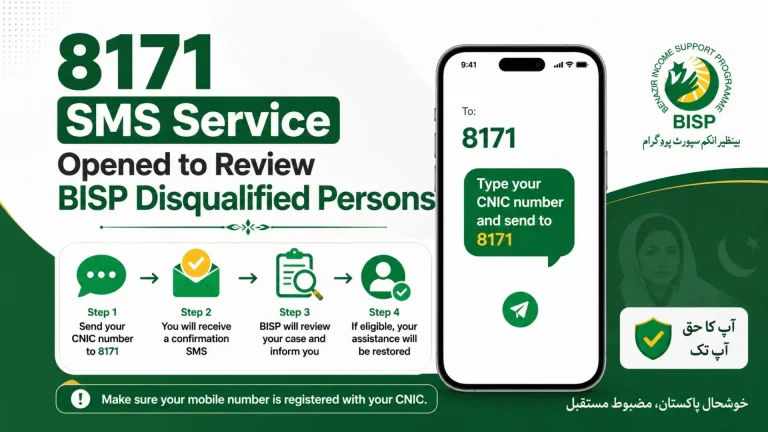
Method 2: SMS Verification (No Internet Required)
For beneficiaries without smartphone access or reliable internet connectivity:
- Open SMS Application – Use any mobile phone with active SIM
- Compose Message – Type your 13-digit CNIC number
- Send to 8171 – Transmit to the short code (standard SMS rates apply)
- Receive Response – Status information arrives within minutes via return message
Both methods connect directly to BISP’s centralized database, ensuring identical accuracy regardless of access channel.
BISP April 2026 Payment Structure: What to Expect
Payment Amounts and Distribution Phases
The April 2026 installment follows BISP’s enhanced quarterly distribution model:
| Payment Component | Amount Range | Frequency |
|---|---|---|
| Base Cash Transfer | Rs. 13,500 – Rs. 27,000 | Quarterly |
| Emergency/Flood Relief (if applicable) | Additional Rs. 5,000 – Rs. 25,000 | Situational |
| Taleemi Wazaif (Education Stipends) | Rs. 1,500 – Rs. 4,500 per child | Monthly |
Distribution Channels:
- Designated BISP Campsites – Temporary centers in rural areas
- Authorized Retailers – Partner banks and mobile wallet agents
- Digital Wallets – Direct transfer to JazzCash, Easypaisa, or bank accounts (where activated)
Critical Collection Requirements
When visiting any payment center, always carry:
- Original CNIC – Photocopies not accepted for biometric verification
- Registered Mobile Number – For OTP confirmation where required
- BISP Card (if issued) – Speeds processing at partner locations
Biometric fingerprint verification is mandatory at all physical collection points to prevent identity fraud and ensure funds reach rightful recipients.
Comprehensive Eligibility Criteria for BISP 2026
Mandatory Requirements
To qualify for BISP financial assistance, applicants must satisfy these non-negotiable conditions:
| Criterion | Verification Method |
|---|---|
| Pakistani Citizenship | NADRA CNIC database cross-check |
| Low-Income Household Status | NSER (National Socio-Economic Registry) poverty score below threshold |
| Valid CNIC | Active, non-expired identity card |
| NSER Survey Registration | Participated in door-to-door data collection |
| No Government Employment | Exclusion of households with salaried government workers |
Priority Beneficiary Categories
BISP reserves preferential processing for particularly vulnerable populations:
- Widows – Women who have lost spouses and lack financial support
- Persons with Disabilities – Individuals with documented physical or mental impairments
- Orphan-Supporting Families – Households raising children without parental support
- Women-Led Households – Families where adult women are primary breadwinners
Meeting these priority criteria significantly increases approval probability, though standard eligibility rules still apply.
District-Wide Coverage: Where Payments Are Available
BISP April 2026 distributions span all four provinces plus Azad Jammu & Kashmir and Gilgit-Baltistan:
Punjab Province
Major Centers: Lahore, Faisalabad, Multan, Bahawalpur, DG Khan, Sargodha, Rawalpindi, Gujranwala, Sialkot, Kasur, Okara, Vehari, Khanewal
Sindh Province
Major Centers: Karachi, Hyderabad, Sukkur, Larkana, Mirpurkhas, Nawabshah, Thatta, Badin, Khairpur
Khyber Pakhtunkhwa
Major Centers: Peshawar, Mardan, Swat, Abbottabad, Kohat, Bannu, DI Khan, Charsadda
Balochistan
Major Centers: Quetta, Gwadar, Khuzdar, Turbat, Chaman, Zhob, Sibi
AJK & Gilgit-Baltistan
Major Centers: Muzaffarabad, Mirpur, Gilgit, Skardu, Hunza
Payment phases roll out sequentially by district. If your area hasn’t begun distribution yet, the 8171 system will display your scheduled phase date.
Troubleshooting Common Issues
Problem: “CNIC Not Found” Error
Root Causes:
- NSER survey not completed for your household
- Data entry error during registration
- Recent CNIC renewal not synchronized with BISP database
Solutions:
- Visit nearest BISP Tehsil Office for NSER survey update
- Verify CNIC number entry (common transposition errors)
- Allow 7-10 days after NADRA renewal for database synchronization
Problem: Payment Status Not Displaying
Likely Explanations:
- Your district’s distribution phase hasn’t commenced
- Previous installment collection pending (blocks new release)
- Account flagged for verification review
Recommended Actions:
- Wait 48-72 hours and recheck (system updates nightly)
- Contact helpline if status unchanged beyond one week
- Visit office if “Under Review” status persists beyond 10 days
Problem: Biometric Verification Failure
Technical Causes:
- Faded fingerprints due to manual labor/age
- NADRA database quality issues
- Scanner malfunction at specific retailer
Resolution Path:
- Visit NADRA office for biometric re-registration with updated fingerprints
- Attempt collection at alternate BISP center or retailer
- Request manual verification with additional documentation at Tehsil Office
Problem: Incorrect Personal Information
Data Discrepancies:
- Spelling errors in name
- Wrong date of birth
- Incorrect family composition
Correction Process: Submit correction request at BISP office with:
- Original CNIC
- Supporting documents (birth certificates, marriage certificates)
- Signed application form
BISP Taleemi Wazaif: Education Support Program
Beyond basic cash transfers, BISP operates the Taleemi Wazaif initiative promoting children’s school enrollment and attendance.
Program Benefits
| Education Level | Monthly Stipend | Attendance Requirement |
|---|---|---|
| Primary (Grades 1-5) | Rs. 1,500 per child | 70% monthly attendance |
| Secondary (Grades 6-8) | Rs. 2,500 per child | 70% monthly attendance |
| Higher Secondary (Grades 9-12) | Rs. 4,500 per child | 70% monthly attendance |
Eligibility Conditions
- Parent/Guardian: Active BISP beneficiary
- Child: Enrolled in government-registered school
- Verification: B-form/CRC linked to parent’s CNIC
- Compliance: Satisfactory attendance record
This conditional cash transfer approach has demonstrated measurable impact on reducing dropout rates, particularly for girls in rural areas.
2026 System Improvements: What’s New
The current 8171 platform incorporates several enhancements over previous versions:
- Accelerated Distribution – Optimized payment processing reduces wait times between phases
- Increased Financial Allocation – Higher per-household amounts reflecting inflation adjustment
- Streamlined Verification – Enhanced biometric algorithms reduce false rejection rates
- Expanded Eligibility – Recent NSER updates include newly qualified families previously excluded
- Digital Payment Expansion – Growing network of mobile wallet and bank account direct deposits
These upgrades reflect BISP’s commitment to efficient, dignified service delivery for Pakistan’s most vulnerable citizens.
Official Support Channels
For issues beyond self-service resolution:
| Channel | Contact | Best For |
|---|---|---|
| Toll-Free Helpline | 0800-26477 | Complex eligibility questions, complaint registration |
| SMS Service | 8171 | Quick status checks, balance inquiries |
| In-Person Support | Nearest BISP Tehsil Office | Biometric issues, data corrections, grievances |
| Official Website | bisp.gov.pk | Policy information, form downloads, announcements |
Critical Warning: BISP never requests payment for registration, status checks, or payment collection. Any individual demanding money for these services is committing fraud. Report immediately to official channels.
Conclusion
The 8171 Payment CNIC Check Online 2026 system exemplifies how digital governance can transform social protection delivery. By placing real-time information directly in beneficiaries’ hands, BISP eliminates information asymmetries that previously enabled exploitation.